
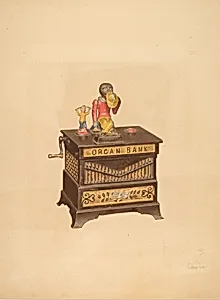
Toy Bank: Monkey and Hurdy-Gurdy
c. 1939
Medium
watercolor and graphite on paperboard
Dimensions
overall: 40.7 x 30.5 cm (16 x 12 in.) Original IAD Object: 4 1/2" high; 4 7/8" wide; monkey: 2 7/8" high
Classification
Index of American Design
Department
CG-W
Museum
National Gallery of Art, Washington, D.C.
Credit
Index of American Design
Accession Number
1943.8.8486
Rights
Public Domain
Art Historical Context
Discover the whimsical "Toy Bank: Monkey anddy-Gurdy," a vibrant watercolor and graphite rendering by Cushman Parker, created around 1939. This detailed depiction captures a charming 19th-century mechanical toy, standing just 4½ inches high, featuring a seated monkey cranking a hurdy-gdy. Parker's precise technique on paperboard brings the folk object's playful mechanics to life—imagine inserting a coin to see the monkey "play" its stringed instrument, a nod to the era's popular cast-iron novelties that delighted children and collectors alike. As part of the Index of American Design (IAD), a Works Progress Administration (WPA) project from 1935 to 1942, this artwork holds key historical significance. Sponsored by the Federal Art Project during the Great Depression, the IAD commissioned artists like Parker to document America's everyday folk crafts through accurate, colorful renderings. Housed in the National Gallery of Art's collection, it preserves vanishing cultural artifacts, highlighting how toy banks blended whimsy with ingenuity in American material culture. Parker's rendering not only showcases the toy's intricate details—from the monkey's expressive face to the hurdy-gurdy's bellows—but also celebrates regional craftsmanship, likely from the Northeast. A delightful window into Depression-era preservation efforts, it reminds us of toys as cherished heirlooms bridging play and history.