
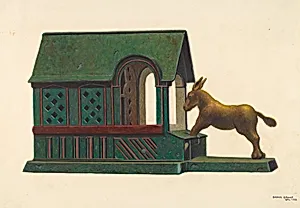
Toy Bank: Mule and Manger
c. 1942
Medium
watercolor, graphite, and gouache on paperboard
Dimensions
overall: 23 x 30.6 cm (9 1/16 x 12 1/16 in.) Original IAD Object: overall: 10" long; mule: 3 1/2" high; bank: 5 1/2" high; 5" long, 4" wide.
Classification
Index of American Design
Department
CG-W
Museum
National Gallery of Art, Washington, D.C.
Credit
Index of American Design
Accession Number
1943.8.17139
Rights
Public Domain
Art Historical Context
**Toy Bank: Mule andanger** *Artist: D.J. Grant, c. 1942* *Watercolor, graphite, and gouache on paperboard, 23 x 30.6 cm (9 1/16 x 12 1/16 in.)* *Index of American Design, National of Art* Step into the whimsical world of American folk art with D.J. Grant's vibrant rendering of *Toy Bank: Mule andanger*, created around 1942. This watercolor, graphite, and gouache on paperboard captures a charming toy bank featuring a sturdy mule beside a manger, evoking humble nativity scenes or everyday farm life. The original object—a compact 10-inch-long plaything with the mule standing 3½ inches high and the bank measuring 5½ inches tall—highlights the ingenuity of handmade American toys from earlier eras, blending functionality with festive spirit. As part of the Index of American Design (IAD), a Federal Art Project under the Works Progress Administration (WPA) during the Great Depression, Grant's piece preserves vanishing examples of vernacular craftsmanship. Launched in 1935, the IAD commissioned artists to produce precise, colorful plates documenting regional folk objects, ensuring their legacy for future generations. Grant's meticulous technique—layering translucent watercolors over graphite sketches and opaque gouache—brings the toy's textures and colors to life, showcasing the era's commitment to celebrating everyday American creativity. This artwork underscores the cultural importance of folk toys as affordable joys amid hardship, reflecting values of thrift, faith, and whimsy in mid-20th-century America. A delightful window into our design heritage! (198 words)