
Toy in the form of a makara
Unknown Artist
1st century CE
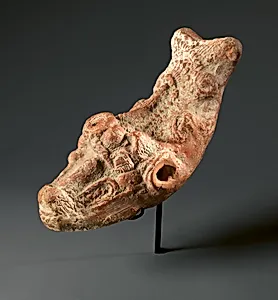
Medium
Terracotta
Dimensions
H. 3 in. (7.6 cm); W. 2 7/8 in. (7. 3 cm); L. 7 1/8 in. (18.1 cm)
Classification
Ceramics
Culture & Period
India (Uttar Pradesh, probably Kausambi) · Kusana
Department
Asian Art
Museum
Metropolitan Museum of Art, New York, NY
Credit
Purchase, Rogers Fund, by exchange, 2010
Accession Number
2010.207
Rights
Public Domain
Tags
Art Historical Context
This charming terracotta toy, shaped as a makara—a mythical aquatic creature blending elephant, fish, and crocodile features—hails from 1st-century CE India, likely the ancient city of Kaus in Uttar Pradesh during the Kusana period. just 3 inches high, 2⅞ inches wide, and7⅛ inches long, its compact form suggests it was crafted for a child's grasp, evoking the playful yet fantastical world of ancient toys now housed in the Metropolitan Museum of's Asian Art Department. In Hindu and Buddhist mythology, the makara symbolizes the churning waters of the cosmos, often depicted spouting from temple spouts or as the vahana (mount) of river goddess Ganga. This artifact bridges the sacred and everyday: terracotta, an accessible fired clay medium, allowed widespread production of such figurines, reflecting the Kusana era's cultural synthesis under Indo-Greek, Persian, and Indian influences. As a toy, it offers a rare glimpse into childhood in a bustling trade hub like Kausambi, where mythical motifs inspired playthings. The Rogers Fund purchase highlights its value—preserving how ancient artisans hand-modeled or molded these lively creatures, capturing motion in curved tails and open jaws, blending whimsy with profound symbolism for Kusana society.