
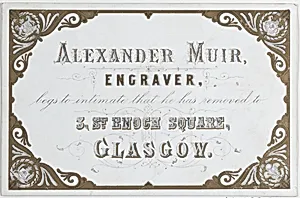
Trade Card for Alexander Muir, Engraver
19th century
Medium
Commercial Lithograph
Dimensions
Sheet: 2 15/16 × 4 7/16 in. (7.4 × 11.3 cm)
Classification
Prints|Ephemera
Department
Drawings and Prints
Museum
Metropolitan Museum of Art, New York, NY
Credit
The Elisha Whittelsey Collection, The Elisha Whittelsey Fund, 1966
Accession Number
66.630.3
Rights
Public Domain
Art Historical Context
Step into the bustling world of 19th-century British commerce with this charming *Trade Card for Alexander Muir, Engraver Produced anonymously as a commercial lithograph, this petite print (just 2 15/16 × 4 7/16 inches) served as a pocket-sized advertisement for Muir's engraving services. Trade cards like this one were the business cards of the Victorian era—widely distributed, collected by enthusiasts, and a clever way for artisans to showcase their craft amid the Industrial Revolution's print boom. Lithography, the medium here, revolutionized printing in the 1800s by allowing artists to draw directly on stone with greasy ink, enabling affordable, high-quality reproductions in multiple colors. This technique democratized advertising, turning everyday ephemera into vibrant marketing tools that reflected Britain's growing consumer culture. As part of the Metropolitan Museum of Art's Elisha Whittelsey Collection, it offers a glimpse into the era's skilled tradespeople, like engravers who produced intricate designs for books, maps, and invitations. Though modest in scale, this card captures the ingenuity of 19th-century printmaking, blending artistry with entrepreneurship. A delightful artifact for collectors of graphic history!
About the Artist
Anonymous, British, 19th century · 1800–1900
**Anonymous, British, 19th century** is not the name of a single individual but a standard museum attribution used for works whose creators remain unidentified yet are clearly British and date to the 1800s. Major institutions, including the Metropolitan Museum of Art, employ this designation for hundreds of drawings, prints, designs, and decorative studies that lack signatures or firm documentary ...