
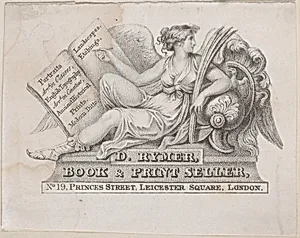
Trade Card for D. Rymer, Book & Print Seller
18th century
Medium
Engraving
Dimensions
Sheet: 2 15/16 × 3 7/8 in. (7.4 × 9.8 cm)
Classification
Prints|Ephemera
Department
Drawings and Prints
Museum
Metropolitan Museum of Art, New York, NY
Credit
Gift of Bella C. Landauer, 1926
Accession Number
26.28.367
Rights
Public Domain
Art Historical Context
Step into the bustling world of 18th British commerce with this delightful trade card for D. Rymer, a book and print seller. Produced anonymously by a British engraver, this petite engraving (just under 3 by 4 inches) served as an early form of advertising, much like today's business cards. Shopkeepers distributed these to customers, often featuring eye-catching designs to promote their wares—here, likely books, prints, and stationery that catered to a growing literate public amid the Enlightenment's thirst for knowledge. Engraving, the medium of choice, allowed for intricate details and multiple reproductions from a single copper plate, making it ideal for affordable ephemera. This technique's precision captured the era's refined neoclassical style, blending text and imagery to entice patrons. Trade cards like this one offer a window into urban retail culture, where booksellers were cultural hubs, disseminating literature and art reproductions to the middle class. Preserved in the Metropolitan Museum of Art's Drawings and Prints department through a 1926 gift from Bella C. Landauer, this unassuming print highlights the everyday artistry of advertising. It reminds us how such "throwaway" items preserve slices of history, revealing the vibrant trade networks that fueled Britain's print revolution.