
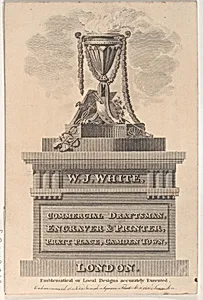
Trade Card for W. J. White, Commercial Draftsman, Engraver & Printer
19th century
Medium
Engraving
Dimensions
Sheet: 4 9/16 in. × 3 in. (11.6 × 7.6 cm)
Classification
Prints|Ephemera
Department
Drawings and Prints
Museum
Metropolitan Museum of Art, New York, NY
Credit
Gift of Bella C. Landauer, 1926
Accession Number
26.28.305
Rights
Public Domain
Art Historical Context
This delicate engraving served as a trade card for W. J. White, a commercialman, engraver, and printer active in nineteenth-century Britain. Measuring just over four by three inches, such cards functioned as portable advertisements, showcasing the very skills their owners offered to clients. The crisp lines and fine detail demonstrate the precision of engraving, a technique prized for its ability to reproduce intricate designs on paper or metal. In an era of expanding commerce and print culture, trade cards like this one bridged art and industry. Anonymous artisans employed engraving not only for beauty but also for clarity and durability, qualities essential for business promotion. The card’s elegant lettering and ornamental borders reflect the period’s taste for refined yet functional design, highlighting how commercial work contributed to the broader visual language of the Victorian age. Acquired by the Metropolitan Museum through the 1926 gift of Bella C. Landauer, this small print preserves a snapshot of everyday artistic enterprise. It reminds viewers that engraving’s technical mastery extended far beyond fine art into the practical world of trade and communication.
About the Artist
Anonymous, British, 19th century · 1800–1900
**Anonymous, British, 19th century** is not the name of a single individual but a standard museum attribution used for works whose creators remain unidentified yet are clearly British and date to the 1800s. Major institutions, including the Metropolitan Museum of Art, employ this designation for hundreds of drawings, prints, designs, and decorative studies that lack signatures or firm documentary ...