
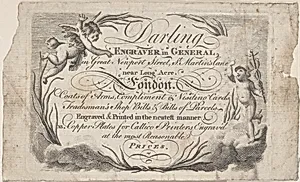
Trade Card for William Darling, Engraver
18th century
Medium
Engraving
Dimensions
Sheet: 3 1/16 × 5 1/16 in. (7.8 × 12.9 cm) Plate: 2 13/16 × 4 3/16 in. (7.2 × 10.7 cm)
Classification
Prints|Ephemera
Department
Drawings and Prints
Museum
Metropolitan Museum of Art, New York, NY
Credit
Gift of Bella C. Landauer, 1926
Accession Number
26.28.236
Rights
Public Domain
Art Historical Context
Step into the bustling world of 18th British commerce with this charming *Trade Card for William Darling, Engraver Created anonymously around the 1700s, this petite engraving (measuring just 3 1/16 × 5 1/16 inches) served as a promotional tool for Darling's engraving services. Trade cards like this were the business cards of their era—small, eye prints distributed by artisans to attract clients, often featuring intricate designs that doubled as skill demonstrations. Engraving, the medium here, involved incising fine lines into a metal plate with a burin tool, then inking and printing to produce sharp, detailed images. For an engraver's card, this technique was especially fitting, showcasing Darling's precision in a self-referential way. As ephemera—printed matter meant to be fleeting—these cards offer a window into everyday economic life, blending art with advertising in an age before mass media. Today, housed in the Metropolitan Museum of Art's Drawings and Prints department (gift of Bella C. Landauer, 1926), it highlights the artistry behind ordinary trades. Imagine a craftsman handing one out on a London street—art history in your pocket!