
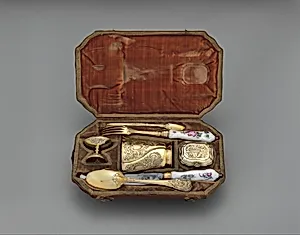
Traveling set in leather case
Medium
Gilded silver, steel, Meissen porcelain, tooled leather, velvet
Dimensions
Length (Fork [a]): 8 13/16 in. (22.4 cm); Length (Knife [b]): 10 1/16 in. (25.6 cm); Length (Spoon [c]): 7 5/8 in. (19.4 cm); Length (Marrow spoon [d]): 5 7/8 in. (14.9 cm); Overall (Spice box [e]): 1 × 2 3/8 × 2 1/8 in. (2.5 × 6 × 5.4 cm); Overall (Egg cup [f]): 1 3/4 × 2 1/16 × 1 1/4 in. (4.4 × 5.2 × 3.2 cm); Height (Beaker [g]): 3 3/8 in. (8.6 cm); Overall (Case [h]): 2 7/8 × 10 13/16 × 6 3/8 in. (7.3 × 27.5 × 16.2 cm)
Classification
Metalwork-Silver
Culture
German, Augsburg
Department
European Sculpture and Decorative Arts
Museum
Metropolitan Museum of Art, New York, NY
Credit
Gift of The Salgo Trust for Education, New York, in memory of Nicolas M. Salgo, 2010
Accession Number
2010.110.78a–h
Rights
Public Domain
Art Historical Context
This elegant traveling set, crafted in Augsburg around 1745–50, reflects the refined tastes of eighteenth-century European elites who valued portable luxury during journeys. Housed in a tooled leather case lined with velvet, the ensemble includes a gilded silver fork, knife, spoon, marrow spoon, spice box, egg cup, and beaker—each piece designed for practical yet sophisticated dining on the road. Augsburg’s renowned silversmithing tradition, combined with contributions from Johann Mittnacht III, Johann Jakob Bruglocher II, and Johann Ludwig Laminit, highlights the collaborative nature of luxury metalwork in this prosperous German city. The set’s use of gilded silver, steel blades, and delicate Meissen porcelain demonstrates both technical mastery and the era’s fascination with combining precious materials. Meissen’s early porcelain, prized across Europe, adds a note of exclusivity, while the compact, fitted case underscores thoughtful engineering for travel. Such objects were status symbols, allowing wealthy owners to maintain courtly dining rituals wherever they went. Today housed in the Metropolitan Museum of Art’s European Sculpture and Decorative Arts collection, this traveling set offers a vivid glimpse into Rococo-era mobility, craftsmanship, and the blending of utility with opulence.
About the Artist
Johann Mittnacht III|Johann Jakob Bruglocher II|Johann Ludwig Laminit ( |German|German) · 1706 |1710 |1696 –1758 |1752 |1752
1706–1758, master 1735|German, active 1710–52|German, 1696–1752