
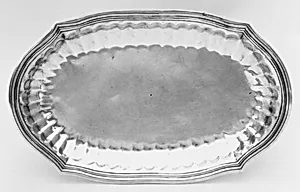
Tray
1744–45
Medium
Silver
Dimensions
Overall: 3/4 × 5 3/4 × 9 3/8 in. (1.9 × 14.6 × 23.8 cm)
Classification
Metalwork-Silver
Culture
French, Angers
Department
European Sculpture and Decorative Arts
Museum
Metropolitan Museum of Art, New York, NY
Credit
Bequest of Catherine D. Wentworth, 1948
Accession Number
48.187.164
Rights
Public Domain
Art Historical Context
This delicate silver tray, crafted by Hugé of Angers, France, around 1744–45, exemplifies the refined metalwork of the French Rococo era. Measuring just 3/4 × 5 3/4 × 9 3/8 inches, it was likely designed for serving small delicacies, tea, or toiletries in an affluent household. Hugé, a master silversmith the provincial center of Angers, showcased the region's renowned tradition of high-quality silver production, blending functionality with subtle ornamentation typical of mid-18th-century decorative arts. Silver trays like this were status symbols, reflecting the opulence of Louis XV's courtly culture even in regional workshops. The medium's luster and malleability allowed artisans like Hugé to employ chasing, engraving, and repoussé techniques, creating pieces that balanced everyday utility with artistic elegance. Angers' silversmiths often drew on local motifs, contributing to France's legacy in luxury goods exported across Europe. Today, this tray graces the Metropolitan Museum of Art's European Sculpture and Decorative Arts collection, thanks to the 1948 bequest of Catherine D. Wentworth. It invites visitors to appreciate the meticulous craftsmanship that turned humble metal into heirloom treasures, bridging art and daily life in ancien régime France.