
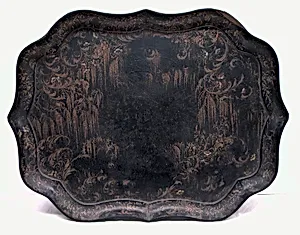
Tray
first half 19th century
Medium
Black lacquered, painted and gilded papier-mâché
Dimensions
Overall: 2 1/4 × 31 × 23 in. (5.7 × 78.7 × 58.4 cm)
Classification
Papier Mâché
Culture
British
Department
European Sculpture and Decorative Arts
Museum
Metropolitan Museum of Art, New York, NY
Credit
Gift of George E. Dix, 1999
Accession Number
1999.50.10
Rights
Public Domain
Art Historical Context
This elegant tray, crafted by British japanner Henry Clay in the first half of the 19th century exemplifies the golden age of papier-mâché decorative arts in England. Made from lightweight, moldable papier-mâché coated in black lacquer, then meticulously painted and gilded, it measures an impressive 31 by 23 inches—perfect for serving tea or displaying confections in a genteel Victorian parlor. Clay, a master from Staffordshire, was renowned for his innovative firm, which popularized these affordable yet luxurious objects amid Britain's growing middle class. The tray's black ground, adorned with gilded motifs, reflects the "japanning" technique—a British adaptation of Asian lacquerware traditions. Popularized in the 18th century and peaking in the 19th, japanning allowed artisans to mimic the glossy, intricate designs of Japanese and Chinese imports using local materials. Papier-mâché's versatility enabled mass production while retaining handcrafted appeal, blending utility with opulence. As a highlight of the Metropolitan Museum of Art's European Sculpture and Decorative Arts collection (gift of George E. Dix, 1999), this tray captures the era's cultural fusion: Oriental inspiration fueling British ingenuity and domestic refinement. Imagine it gracing a Regency soiree, a testament to everyday elegance.