
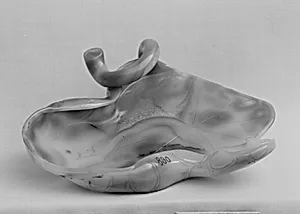
Tray
Unknown Artist
18th century
Medium
Bluish-grey agate
Dimensions
H. 1 5/8 in. (4.1 cm); W. 5 3/4 in. (14.6 cm); D. 5 1/2 in. (14 cm)
Classification
Hardstone
Culture
China
Department
Asian Art
Museum
Metropolitan Museum of Art, New York, NY
Credit
Gift of Heber R. Bishop, 1902
Accession Number
02.18.890
Rights
Public Domain
Art Historical Context
This elegant 18th-century tray, crafted from bluish-grey agate, exemplifies refined artistry of Qing dynasty China. Measuring just 1⅝ inches high, 5¾ inches wide, and 5½ inches deep, its compact form suggests it was designed for intimate use—perhaps to hold seals, incense, or small scholar's objects on a desk or altar. The stone's subtle translucency and cool tones highlight the lapidary's skill in shaping such a hard material without visible tool marks, a testament to the precision of Chinese hardstone carving traditions. In Chinese culture, agate and other semiprecious stones were prized for their durability and natural beauty, often transformed into luxury items for the imperial court or educated elite. During the 18th century, under emperors like Qianlong, workshops produced these objects to symbolize harmony with nature and scholarly refinement. This tray's smooth, unadorned surfaces emphasize the stone's intrinsic qualities over elaborate decoration, reflecting minimalist aesthetics in hardstone art. A generous gift from Heber R. Bishop in 1902, it now graces the Metropolitan Museum of Art's Asian Art collection, inviting visitors to appreciate the quiet sophistication of everyday elegance from imperial China.