
Tray
Unknown Artist
1835–40
Medium
Lacy pressed glass
Dimensions
4 5/8 x 8 1/4 in. (11.7 x 21 cm)
Classification
Tray
Culture
American
Department
The American Wing
Museum
Metropolitan Museum of Art, New York, NY
Credit
Gift of Mrs. Charles W. Green, in memory of Dr. Charles W. Green, 1951
Accession Number
51.171.61
Rights
Public Domain
Art Historical Context
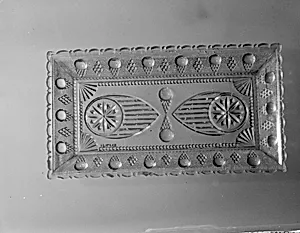
This delicate tray, crafted around 1835–40 by unknown American artist, exemplifies the charm of lacy pressed glass, a hallmark of early American decorative arts. Measuring just 4 5/8 x 8 1/4 inches, its petite scale suggests use as a serving piece for sweets, calling cards, or confections in middle-class homes. Housed in The Metropolitan Museum of Art's American Wing, it was generously gifted in 1951 Mrs. Charles W. in memory of her husband, Dr. Charles W. Green. Lacy pressed glass emerged in the 1820s–1840s as a revolutionary technique, where molten glass was pressed into finely detailed molds to mimic the intricate patterns of lace or needlework. This innovation, pioneered by New England glasshouses like those in Sandwich, Massachusetts, democratized luxury during the Industrial Revolution. Affordable yet elegant, it allowed everyday Americans to enjoy ornate tableware previously reserved for the elite, blending functionality with folk artistry. As a snapshot of antebellum domestic life, this tray reflects growing American consumerism and pride in homegrown craftsmanship amid rapid industrialization. Its crisp textures and translucency invite visitors to appreciate how glassmaking fused utility and beauty, shaping the nation's material culture.