
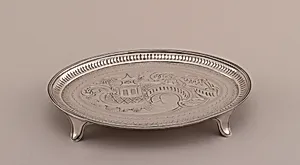
Tray with Man on Bridge near a Pagoda
Medium
metalwork
Classification
metalwork
Department
Smithsonian Collection
Museum
Smithsonian American Art Museum
Credit
Gift of Eleanor and Sarah Hewitt
Accession Number
1931-64-23
Rights
Public Domain
About this artwork
Research in Progress
Art Historical Context
Step into the elegant world of late 18th-century Britishwork with *Tray with Man on Bridge near aoda* by Henry Chawner (1764–1851). Crafted around 1790–91, this finely wrought tray captures a serene chinoiserie scene—a lone figure poised on a delicate bridge beside an ornate pagoda. Chawner, a skilled London silversmith, exemplifies the era's mastery in decorative metal objects, likely employing techniques like chasing or engraving to bring exotic motifs to life on silver or plated surfaces. This piece reflects the height of chinoiserie mania in Britain, fueled by expanding trade with China and a Romantic fascination with the "Orient." During the reign of George III, such trays graced dining tables and sideboards in fashionable homes, blending European craftsmanship with imagined Eastern splendor. The pagoda and bridge evoke willow-pattern ceramics and wallpapers, symbolizing cultural exchange amid imperial expansion. Now part of the Smithsonian American Art Museum's collection—thanks to a gift from collectors Eleanor and Sarah Hewitt—this tray highlights Chawner's contributions to neoclassical decorative arts. Though research continues, it invites us to ponder how everyday objects carried the dreams of distant lands into British parlors.