
Tree
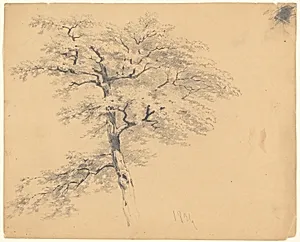
Medium
graphite on wove paper
Dimensions
sheet: 23.02 × 28.58 cm (9 1/16 × 11 1/4 in.)
Classification
Drawing
Department
CG-W
Museum
National Gallery of Art, Washington, D.C.
Credit
Corcoran Collection (Gift of J. William Middendorf, II)
Accession Number
2015.19.2667
Rights
Public Domain
Art Historical Context
James Goodwyn Clon's *Tree* (1839) is a refined graphite drawing on wove paper, measuring 23.02 × 28.58 cm. Created during the artist's early career in America, this intimate study showcases his meticulous draftsmanship. Clonney, an English-born painter who emigrated to the United States in the 1830s, was renowned for his lively genre scenes of rural life, often infused with humor and everyday charm. Here, the simple subject—a solitary tree—highlights his foundational skills in capturing nature's forms with graphite's versatile range of tones, from soft shadows to crisp outlines. Wove paper, with its smooth, even texture free of laid lines, was ideal for detailed pencil work in the 19th century, allowing artists like Clonney to build depth and texture effortlessly. This medium reflects the era's growing emphasis on preparatory sketches as standalone artworks, bridging Romanticism's awe for nature and the emerging precision of American landscape traditions. Now part of the Corcoran Collection at the National Gallery of Art (gift of J. William Middendorf II), *Tree* offers visitors a glimpse into Clonney's process, reminding us how humble studies can reveal an artist's keen observation of the natural world amid America's expanding frontiers.
About the Artist
James Goodwyn Clonney · 1812–1867
James Goodwyn Clonney (1812–1867) was an American genre painter and miniaturist whose warm, gently humorous depictions of rural and small-town American life place him among the most appealing practitioners of the antebellum genre tradition. Born in England and brought to the United States as a child, he studied drawing and miniature painting in New York and worked for a period as a miniature portr...