
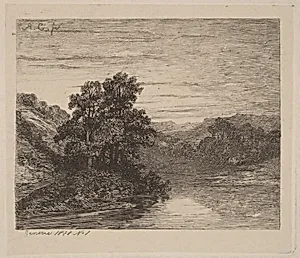
Trees by a River
1838
Medium
etching on wove
Dimensions
plate: 8.9 x 9.9 cm (3 1/2 x 3 7/8 in.) sheet: 27.2 x 35.8 cm (10 11/16 x 14 1/8 in.)
Classification
Portfolio
Department
CG-E
Museum
National Gallery of Art, Washington, D.C.
Credit
Ailsa Mellon Bruce Fund
Accession Number
2009.129.2
Rights
Public Domain
Art Historical Context
Nestled within the National Gallery of Art's collection, *Trees by a River* (1838) is a delicate etching by Swiss Romantic artist Alexandre Calame. Born in 1810, Calame rose to prominence in the mid-19th century for his evocative landscapes that celebrated the sublime beauty of nature, often drawing from the majestic Swiss Alps and waterways. This intimate print, acquired through the Ailsa Mellon Bruce Fund, captures a tranquil riverside scene with trees, evoking the Romantic era's reverence for the untamed wilderness amid Europe's growing industrialization. Crafted as an etching on wove paper—a smooth, fine sheet ideal for capturing intricate details—the work measures a modest plate size of 8.9 x 9.9 cm, housed within a larger 27.2 x 35.8 cm sheet, suggesting it was part of a collector's portfolio (Department CG-E). Etching allowed Calame to translate his painterly touch into precise lines bitten into a metal plate by acid, producing rich tonal contrasts that mimic the play of light on water and foliage. This technique democratized his grand visions, making nature's poetry accessible beyond oil canvases. Calame's mastery lies in infusing everyday motifs with emotional depth, inviting viewers to pause and reflect on nature's quiet power—a perfect gem for museum-goers seeking the era's artistic soul.
About the Artist
Alexandre Calame · 1810–1864
Comment on works: Landscapes