
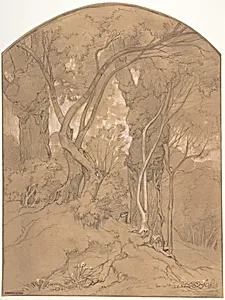
Trees in a Forest
Medium
Black chalk, heightened with white
Dimensions
Sheet: 14 3/8 x 10 13/16 in. (36.5 x 27.4cm)
Classification
Drawings
Department
Drawings and Prints
Museum
Metropolitan Museum of Art, New York, NY
Credit
Purchase, Karen B. Cohen Gift, in honor of Jacob Bean, 1987
Accession Number
1987.231
Rights
Public Domain
Tags
About this artwork
This black chalk, heightened with white, created in 1800–1880, represents significant artistic achievement by Edouard Bertin, a French artist. The piece demonstrates the technical capabilities and aesthetic conventions of French art during this historical period. Working in black chalk, heightened with white, the artist employed materials and techniques characteristic of the era, creating visual effects that convey both subject matter and artistic vision. Museum collections preserve such works t...
Art Historical Context
Nestled within the Metropolitan Museum of Art Drawings and Prints collection, *Trees in a Forest* French artist Édouard Bertin captures the quiet majesty of nature through a delicate drawing in black chalk heightened with white. Created sometime between 1800 and1880, this 14⅜ × 10⅞-inch sheet exemplifies the intimate scale and technical finesse of 19th-century draftsmanship. Bertin's work reflects the era's fascination with landscape as a subject, evoking the dense, atmospheric beauty of wooded scenes that invited viewers to immerse themselves in the natural world. The medium—black chalk enriched with white highlights—allowed Bertin to masterfully render light filtering through foliage, creating depth, texture, and subtle luminosity on paper. This technique, characteristic of French academic and Romantic traditions, balanced shadow and glow to convey both realism and poetic vision, showcasing the artist's skill in achieving volume and movement without color. Preserved through the museum's careful stewardship, including the 1987 purchase funded by the Karen B. Cohen Gift in honor of Jacob Bean, this drawing offers a window into French artistic practices of the time. It highlights cultural values placed on nature studies, inviting scholars and visitors alike to appreciate the evolution of drawing as a foundational art form and the enduring legacy of 19th-century creativity.