
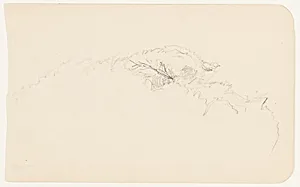
Treetops, Mexico
Medium
Drawing
Classification
Drawing
Department
Smithsonian Collection
Museum
Smithsonian American Art Museum
Credit
Gift of Louis P. Church
Accession Number
1917-4-1235-c
Rights
Public Domain
About this artwork
Research in Progress
Art Historical Context
**Treetops, Mexico** is a delicate drawing by Frederic Edwin Church, one of America's foremost landscape artists of the 19th century and a leading figure in the Hudson River School. Born in 1826, Church was celebrated for his luminous, detailed depictions of nature, often inspired by extensive travels to exotic locales like South America and the Arctic. Created between 1890 and 1893, this late-career work captures the intricate canopy of Mexican treetops, offering a intimate glimpse into Church's enduring fascination with the natural world. As a drawing rather than one of Church's grand oil paintings, *Treetops, Mexico* highlights his mastery of graphite or similar media on paper, a medium that allowed for precise observation and subtle tonal effects. By the 1890s, Church's health had declined due to rheumatoid arthritis, shifting his focus toward smaller-scale studies like this one. The title evokes a bird's-eye view of lush foliage, reflecting his lifelong pursuit of nature's sublime beauty and perhaps a personal journey to Mexico in his later years. Now housed in the Smithsonian American Art Museum as part of the Smithsonian Collection, the work was generously gifted by Church's son, Louis P. Church. Though research continues, it stands as a poignant testament to an artist's unyielding vision, inviting visitors to ponder the quiet poetry hidden in treetop silhouettes.