
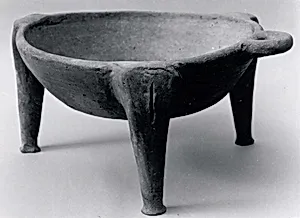
Tripod bowl
Unknown Artist
2nd millennium BCE
Medium
Ceramic
Dimensions
6 in. (15.24 cm)
Classification
Ceramics-Vessels
Period
Middle–Late Bronze Age
Department
Ancient Near Eastern Art
Museum
Metropolitan Museum of Art, New York, NY
Credit
Gift of Warren A. Silver, 1954
Accession Number
54.55.15
Rights
Public Domain
Art Historical Context
This elegant tripod bowl, crafted by an unknown artist during the Middle–Late Bronze Age (2nd millennium BCE), exemplifies the ceramic traditions of the Ancient Near East. Standing just 6 inches (15.24 cm) tall, its three sturdy legs elevate the shallow basin, providing stability on uneven surfaces—a practical innovation for a vessel likely used in households, rituals, or communal feasts. Housed in the Metropolitan Museum of Art's of Ancient Near Eastern Art it entered the collection as a gift from Warren A. Silver in 1954. In the Bronze Age Near East—from Mesopotamia to the Levant—potters mastered firing techniques in kilns, producing durable ceramics that bridged everyday utility and symbolic function. Tripod vessels like this one were widespread, possibly for holding offerings or liquids during ceremonies, reflecting the era's burgeoning trade networks and cultural exchanges among Hittites, Canaanites, and others. The form's portability and heat-resistant design hint at its role in nomadic or early urban life. Though simple in form, this bowl captures the ingenuity of ancient artisans, who shaped clay without wheels in many cases, burnishing surfaces for a smooth finish. It invites us to ponder the daily rhythms of Bronze Age societies, where such objects were both tools and treasures.