
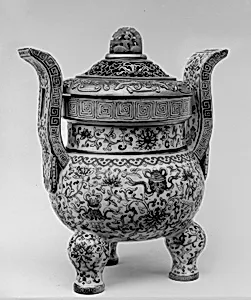
Tripod incense burner with Buddhist auspicious symbols
Unknown Artist
late 18th–early 19th century
Medium
Porcelain painted in overglaze polychrome enamels (Jingdezhen ware), wooden cover with jade knob
Dimensions
H. with cover: 12 1/2 in. (31.8 cm)
Classification
Ceramics
Culture & Period
China · Qing dynasty (1644–1911), Jiaqing mark and period (1796–1820)
Department
Asian Art
Museum
Metropolitan Museum of Art, New York, NY
Credit
Mr. and Mrs. Isaac D. Fletcher Collection, Bequest of Isaac D. Fletcher, 1917
Accession Number
17.120.196a, b
Rights
Public Domain
Art Historical Context
This elegant tripod incense burner, crafted in Jingdezhen porcelain during the Jiaqing period (1796–1820) of China's Qing dynasty, exemplifies the era's masterful ceramic artistry. Standing 12½ inches tall with its wooden cover topped by a carved jade knob, the burner features a vibrant overglaze polychrome enamel decoration adorned with Buddhist auspicious symbols—motifs like lotus flowers, endless knots, and mythical creatures that promised prosperity, purity, and protection. Produced at Jingdezhen, the imperial porcelain capital, such wares were prized for their technical precision and luxurious appeal, often destined for scholarly studios, temples, or elite altars. The overglaze enameling technique, applied after the initial firing and refired at lower temperatures, allowed for a dazzling array of colors unattainable in traditional underglaze methods. This innovation highlighted the Qing court's patronage of the arts, blending Confucian refinement with Buddhist spirituality during a time of cultural flourishing under Emperor Jiaqing. Tripod forms, evoking ancient bronze ritual vessels, connected the piece to millennia of Chinese ceremonial tradition, making it both functional for burning incense in meditation or offerings and a symbol of harmonious cosmic order. Now part of the Metropolitan Museum of Art's Asian Art collection, thanks to the Isaac D. Fletcher bequest of 1917, this burner invites visitors to appreciate the Qing dynasty's fusion of spirituality, technology, and timeless beauty.