
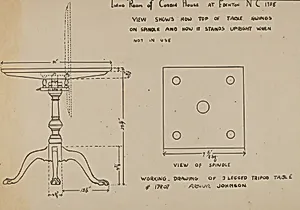
Tripod Table
c. 1936
Medium
pen and ink and graphite on paper
Dimensions
overall: 15.3 x 22.2 cm (6 x 8 3/4 in.) Original IAD Object: 29"high; 31 1/2"diameter, top.
Classification
Index of American Design
Department
CG-W
Museum
National Gallery of Art, Washington, D.C.
Credit
Index of American Design
Accession Number
1943.8.5792
Rights
Public Domain
Art Historical Context
**Tripod Table** *Arthur Johnson, c. 1936* Pen and ink and graphite on, 15.3 × 22.2 cm (6 × 8 3/4 in.) *Index of American Design, National Gallery of Art* delicate pen and ink drawing with graphite highlights by Arthur Johnson captures the elegant form of a classic American tripod table, standing 29 inches high with a31½-inch diameter top. The rendering showcases the table's graceful three-legged base and circular top, likely inspired by 18th- or early 19th-century furniture traditions. Johnson's precise lines and subtle shading bring out the wood's grain and curves, emphasizing functionality blended with understated beauty—a hallmark of vernacular American design. Created as part of the Index of American Design (IAD), a Works Progress Administration (WPA) project from the 1930s, this work reflects New Deal efforts to document and celebrate the nation's artistic heritage during the Great Depression. Artists like Johnson produced thousands of such detailed renderings of folk art, crafts, and everyday objects, preserving cultural artifacts for future generations. Housed in the National Gallery of Art's collection, it highlights how simple household items embodied regional craftsmanship and colonial influences. Through Johnson's meticulous technique—combining ink's bold contours with graphite's soft modeling—the drawing not only records a physical object but also evokes the ingenuity of American makers. It's a window into a time when design served both utility and quiet artistry, inviting us to appreciate the everyday poetry in our shared history.
About the Artist
Arthur Johnson · 1855–present
Arthur Johnson is an artist whose biographical details are not well established in the major art historical literature. Without confirmed dates, nationality, or documentation of training, it is not possible to place him with confidence within a particular school, movement, or cultural tradition. The name Arthur Johnson is common enough that confusion among multiple individuals of the same name ma...