
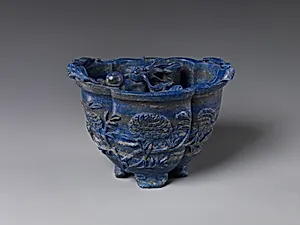
清 青金石龍紋鼎|Tripod with dragon
Unknown Artist
18th century
Medium
Lapis lazuli
Dimensions
H. 3 7/8 in. (9.8 cm); L. 5 1/8 in. (13 cm)
Classification
Hardstone
Culture & Period
China · Qing dynasty (1644–1911),
Department
Asian Art
Museum
Metropolitan Museum of Art, New York, NY
Credit
Gift of Heber R. Bishop, 1902
Accession Number
02.18.920
Rights
Public Domain
Tags
Art Historical Context
This exquisite lapis lazuli tripod, in 18th-century Qing dynasty China, stands as a testament to the era's mastery of hardstone carving. Measuring just under 4 inches tall and 5 inches long, the small vessel takes the ancient ritual form of a *ding—a three-legged bronze cauldron from China's Bronze Age—but reimagined as a luxurious tabletop ornament. Its deep blue lapis lazuli, sourced from distant Afghanistan and highly prized in imperial workshops, glows with an otherworldly richness, symbolizing the heavens and imperial prestige. Adorned with intricate dragon motifs intertwined with delicate plant forms, the piece embodies Qing opulence and scholarly refinement. Dragons, eternal emblems of power, protection, and the emperor's divine mandate, writhe dynamically across the surface, while stylized plants evoke harmony with nature. Carving such a hard, brittle material demanded exceptional precision, likely from palace artisans, highlighting technical virtuosity in a period of peak artistic patronage under emperors like Qianlong. A gift to the Metropolitan Museum of Art from Heber R. Bishop in 1902, this rare hardstone treasure offers visitors a glimpse into Qing China's fusion of ancient symbolism and exquisite craftsmanship, bridging ritual tradition with elite connoisseurship.