
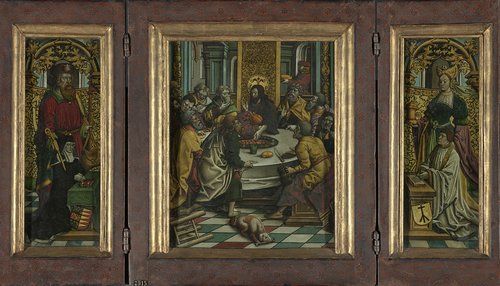
Triptych with the Last Supper (centre panel), Adriana van Roon (c. 1450-1527) with St James the Greater (inner left wing), Dirk Pietersz Spangert (c. 1465-1549) with St Mary Magdalen (inner right wing), the coats of arms of Adriana van Roon (outer left wing) and the Spangert house mark (outer right wing)
c. 1525 - c. 1530
Medium
oil on glass
Dimensions
45; 20; 18.7; 39; 45; 45
Rights
Public Domain
About this artwork
wapen (heraldiek), linkerluik: ‘divided vertically, 1, on a silver field a horizontal red bar charged with a gold demi-lion flanked by 15 oblong green blocks, five over four above the bar and three over two over one below the bar; 2, one half and four whole triangular gold pieces on a red field’
Art Historical Context
This striking triptych, painted around 1525–1530 by Jacob Cornelisz van Oostsanen, blends religious devotion with personal commemoration. The central panel depicts the Last Supper, while the inner wings portray Adriana van Roon alongside her patron saint, St James the Greater, and her husband Dirk Pietersz Spangert with St Mary Magdalen. The outer wings display the couple’s coats of arms, underscoring their identity and status. Such donor portraits were common in early sixteenth-century Netherlandish art, allowing wealthy patrons to be eternally present in prayer before sacred scenes. Executed in the unusual medium of oil on glass, the work would have created luminous effects when held to light or placed in a domestic setting. Van Oostsanen, a leading Amsterdam artist of the Northern Renaissance, skillfully combined detailed heraldic symbols with intimate likenesses, transforming a traditional religious format into a deeply personal object. Today housed in the Rijksmuseum, the triptych offers a vivid glimpse into the spiritual and social world of prosperous Dutch citizens during the Reformation era.