
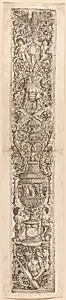
Triton and Two Infant Satyrs, plate four from Twelve Ornament Panels
c. 1505–15
Medium
Engraving in black on grayish cream laid paper
Dimensions
Plate: 53.1 × 8.5 cm (20 15/16 × 3 3/8 in.); Sheet: 55.2 × 11.5 cm (21 3/4 × 4 9/16 in.)
Classification
engraving
Department
Prints and Drawings
Museum
Art Institute of Chicago
Accession Number
23434
Rights
Public Domain
About this artwork
This print exemplifies a type of ornamental design that enjoyed wide popularity in the 15th and 16th centuries. Featuring fanciful decorative vases, fragments of armor, symmetrical acanthus scrolls, fantastic creatures, and frolicking putti, it was inspired by painted and carved architectural decorations from Roman antiquity. A significant number of very early engravings depict ornamental designs, suggesting there was considerable demand for them among artists, craftsmen, scholars, and collector...
Art Historical Context
In the early 16th century, Venetian engraver Giovanni Antonio da crafted *Triton and Two Satyrs*, plate four his series *Twelve Ornament Panels (c. 1505–15). This exquisite engraving captures the High Renaissance fascination with classical mythology, blending the muscular sea god Triton—often depicted blowing a conch shell—with playful infant satyrs, half-human creatures symbolizing untamed nature and revelry. Da Brescia, renowned for reproducing designs by masters like Raphael, created these panels as decorative motifs, ideal for friezes, furniture, or architectural ornamentation, reflecting Italy's booming interest in antiquity-inspired decoration. Executed in black ink on grayish cream laid paper (plate: 53.1 × 8.5 cm), the work showcases engraving's precision: fine lines incised into a copper plate, inked, and pressed to produce multiples. This technique revolutionized art dissemination, allowing intricate Renaissance ornament to reach collectors across Europe affordably. Housed in the Art Institute of Chicago's Prints and Drawings department, it exemplifies how prints bridged elite design with broader audiences, turning myth into everyday elegance. Imagine Triton amidst frolicking satyrs—a whimsical snapshot of Renaissance humanism's joy in the fantastical!