
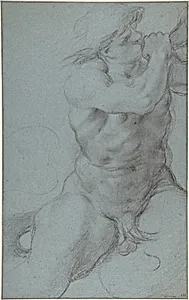
Triton Sounding a Conch Shell
ca. 1597–1602
Medium
Charcoal or soft black chalk on blue-gray paper; traces of framing outlines in pen and black ink and black chalk
Dimensions
Sheet: 15 1/4 x 9 9/16 in. (38.8 x 24.3 cm)
Classification
Drawings
Department
Drawings and Prints
Museum
Metropolitan Museum of Art, New York, NY
Credit
Rogers Fund, 1970
Accession Number
1970.15
Rights
Public Domain
Tags
Art Historical Context
Annibale Carracci’s *Triton Sounding a Conch Shell* captures the dynamic energy of a mythological sea creature in a powerful study of the male nude. Created around 1597–1602, during Carracci’s most productive Roman years, the drawing reflects the artist’s pivotal role in shifting Italian art from Mannerist elegance toward the vigorous naturalism of the early Baroque. Carracci often drew from live models to explore anatomy and movement, and this sheet likely served as preparation for a larger fresco or painting featuring marine subjects. Executed in charcoal or soft black chalk on blue-gray paper, the work demonstrates the artist’s mastery of tonal contrast and fluid line. The cool paper tone allowed Carracci to build rich shadows and highlights, giving the Triton’s muscular form a striking sense of volume and immediacy. Traces of framing lines suggest the drawing was carefully considered as an independent study or presentation piece. Today in the Metropolitan Museum’s collection, this work offers visitors a rare glimpse into Carracci’s creative process. It celebrates both the physical vitality of the human body and the enduring appeal of classical mythology reimagined through Baroque eyes.
About the Artist
Annibale Carracci · 1560–1609
Annibale was considered one of the greatest Italian painters of his age. His style is marked by naturalism combined with the formal language of Classicism in a grand and monumental style. Annibale was also instrumental in evolving the ideal, classical landscape and is generally credited with the invention of caricature. Italian painter. Comment on works: Mythology.