
Tritons Abducting Nereids
1547–85
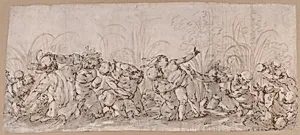
Medium
Pen and dark brown ink, brush and grayish brown wash, over black chalk on three glued sheets of paper. The original paper surface is glued onto the mount; verso not visible.
Dimensions
Length: 32 1/16 in. (81.5 cm) Width: 14 in. (35.5 cm)
Classification
Drawings
Department
Drawings and Prints
Museum
Metropolitan Museum of Art, New York, NY
Credit
Gift of Martha Feltenstein, in celebration of the Museum's 150th Anniversary, 2019
Accession Number
2019.463.2
Rights
Public Domain
Art Historical Context
Luca Cambiaso’s *Tritons Abducting Nereids* captures a dramatic moment from classical mythology, in which powerful sea deities seize the daughters of the sea god Nereus. Created between 1547 and 1585, the large-scale drawing—measuring over thirty-two inches long—unfolds across three joined sheets of paper, allowing the composition to sweep horizontally with vigorous movement and emotional intensity. Cambiaso, a leading figure of the Genoese school, uses the subject to explore the tension between strength and grace that fascinated Renaissance artists. The work is executed in pen and dark brown ink with grayish-brown wash over black chalk, a technique that lets Cambiaso combine precise linear definition with broad, atmospheric shading. The layered washes create a sense of turbulent water and straining bodies, while the chalk underdrawing reveals the artist’s careful planning. Such fluid handling of ink and wash was prized in the sixteenth century for both finished presentation drawings and preparatory studies. Acquired by the Metropolitan Museum as a gift marking its 150th anniversary, this sheet offers visitors a vivid window into Cambiaso’s inventive approach to mythological narrative and his mastery of drawing as an expressive medium in its own right.
About the Artist
Luca Cambiaso · 1527–1585
Luca Cambiaso (1527–1585) was an Italian painter and draftsman who dominated artistic life in Genoa during the second half of the sixteenth century and became one of the most innovative draftsmen of the Late Renaissance. Born in Moneglia near Genoa, he trained under his father, the painter Giovanni Cambiaso, and demonstrated precocious talent, reportedly completing his first public fresco commissi...