
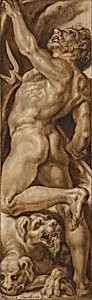
Triumph over Evil: Samson Rending the Lion | Pluto and Cerberus
c. 1555
Medium
paint
Dimensions
h 46.8cm × w 15.1cm
Classification
painting
Museum
Rijksmuseum, Amsterdam
Rights
Public Domain
About this artwork
The young, beardless Samson ripped a ferocious lion apart with just his bare hands. In Heemskerck’s time, this story was regarded as the forerunner (prefiguration) of Christ’s victory over the devil. Pluto, recognizable by his three-headed dog Cerberus, was the guardian of the underworld in classical mythology. In the 16th century he was also identified with the devil from Christianity.
Art Historical Context
In the compact yet dynamic painting *Triumph over Evil Samson Rending the Lion Pluto and Cerberus (c. 1555), Dutch Mannerist artist Maarten van Heemskerck masterfully juxtaposes biblical heroism and classical mythology. The youthful, beardless Samson tears apart a roaring lion with his bare hands a feat captured in dramatic tension. Below or alongside, Pluto—god of the underworld, identifiable by his snarling three-headed dog Cerberusevokes infernal depths. This narrow panel (46.8 × 15.1 cm), likely oil on panel, showcases Heemskerck's skill in small-scale works, influenced by his Roman travels and admiration for Michelangelo's muscular forms. Created during the 16th-century Northern Renaissance amid religious upheaval, the artwork blends Old Testament narrative with Greco-Roman lore. Samson's triumph was interpreted as a prefiguration of Christ's victory over Satan, while Pluto symbolized the Christian devil, reflecting syncretic thinking in Catholic art before the Reformation intensified divides. Heemskerck's Mannerist style—elongated figures, intense expressions, and vivid contrasts—heightens the theme of good prevailing over evil, making this Rijksmuseum gem a poignant emblem of faith's enduring power. Visitors, imagine the lion's fury frozen in paint, whispering ancient triumphs!