
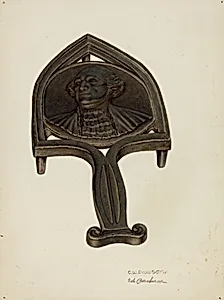
Trivet
c. 1942
Medium
watercolor and graphite on paperboard
Dimensions
overall: 30.5 x 22.8 cm (12 x 9 in.)
Classification
Index of American Design
Department
CG-W
Museum
National Gallery of Art, Washington, D.C.
Credit
Index of American Design
Accession Number
1943.8.15807
Rights
Public Domain
Art Historical Context
**Trivet**, a delicate watercolor and graphite rendering by Edward Bash from around 1942, captures humble beauty of an everyday American household object. Created as part of the Index of American Design—a monumental Works Progress Administration (WPA) during the Great Depression—this artwork exemplifies the era's effort to document and celebrate the nation's folk art and decorative traditions. Bashaw, one of many skilled artists employed by the Federal Project, meticulously depicted a trivet, a sturdy stand used to protect surfaces from hot pots and irons, highlighting its functional elegance in American domestic life. Rendered on paperboard in vibrant watercolor with precise graphite outlines, the piece measures 30.5 x 22.8 cm and showcases the Index's signature style: hyper-realistic accuracy that borders on scientific illustration. This medium allowed for luminous color and fine detail, preserving the trivet's textures, patterns, and craftsmanship for future generations, even as original objects faced wear or loss. Housed in the National Gallery of Art's collection, **Trivet** underscores the cultural importance of ordinary items in shaping American identity. Through the Index, over 18,000 such renderings were produced, fostering national pride in vernacular design and influencing postwar appreciation for folk arts. A charming window into mid-20th-century heritage, it invites us to cherish the artistry in the everyday.