
Trofei di Mario, Rome
1776
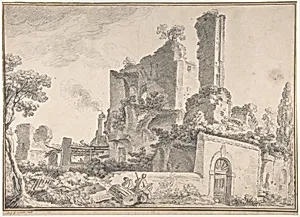
Medium
Black chalk, framing lines in pen and brown ink
Dimensions
12 3/4 x 18 1/8 in. (32.4 x 46.1 cm)
Classification
Drawings
Department
Drawings and Prints
Museum
Metropolitan Museum of Art, New York, NY
Credit
Purchase, Richard and Trude Krautheimer, and David L. Klein Jr. Memorial Foundation Inc. Gifts, 1982
Accession Number
1982.434
Rights
Public Domain
Tags
Art Historical Context
In the heart of Rome's ancient landscape, Louis Chaix's *Trofei di Mario* (1776) captures evocative ruins known as the Trophies of Marius—monumental reliefs honoring the Roman general Gaius Marius's over the Cimbri and Teutones in the 1st century BCE. These weathered sculptures, set amid gates, trees, and scattered human figures, stand as poignant reminders of imperial glory amid decay, a favorite subject for 18th-century travelers on the Grand Tour. Chaix, a French artist working in Italy, renders this scene with meticulous detail, evoking the era's fascination with classical antiquity during the rise of Neoclassicism. Executed in black chalk with framing lines in pen and brown ink, the drawing excels in tonal subtlety. Black chalk allows for soft, atmospheric shading that brings the crumbling stone and foliage to life, while the ink borders give it a finished, framed quality typical of topographic studies. Measuring 12¾ x 18⅛ inches, this intimate work from The Metropolitan Museum of Art's Drawings and Prints department preserves a snapshot of Rome's enduring allure. Such drawings were vital for scholars and artists, disseminating knowledge of Roman heritage across Europe and fueling the neoclassical revival in architecture and sculpture. Today, *Trofei di Mario* invites us to ponder time's gentle erosion on human triumph.