
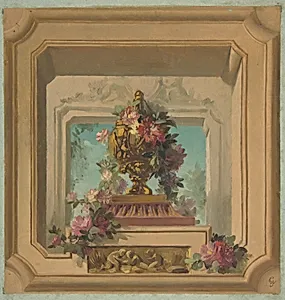
Trompe l'oeil design for a ceiling
second half 19th century
Medium
Oil paint
Dimensions
Overall: 14 3/4 x 10 1/2 in. (37.4 x 26.6 cm)
Classification
Drawings
Department
Drawings and Prints
Museum
Metropolitan Museum of Art, New York, NY
Credit
Dodge Fund, 1967
Accession Number
67.827.514
Rights
Public Domain
Tags
Art Historical Context
This exquisite *Trompe l'oeil for a ceiling*, by French artists Jules-EdmondCharles Lachaise andène-Pierre Gourdet in second half of the th century, showcases the era's fascination with illusionistic art. Rendered in oil paint on a modest scale (14 3/4 x 10 1/2 inches), this preparatory study—housed in the Metropolitan Museum of Art's Drawings and Prints department—was intended as a maquette for grand architectural interiors. Acquired through the Dodge Fund in 1967, it exemplifies the collaborative spirit of 19th-century French decorative workshops. Trompe l'oeil, or "deceive the eye," was a masterful technique perfected during this period, transforming flat surfaces into convincing three-dimensional scenes. Here, intricate motifs of flowers, leaves, vases, and graceful human figures appear to project from the canvas, mimicking ornate ceiling decorations popular in opulent Second Empire mansions and public buildings. The oil medium lent rich depth and luminosity, blurring the line between painting and sculpture. In the context of France's booming decorative arts scene, such designs reflected a cultural revival of Renaissance illusionism amid industrialization, blending natural abundance with human elegance to elevate everyday spaces into theatrical wonders. A delightful glimpse into lost grandeur!
About the Artist
Jules-Edmond-Charles Lachaise|Eugène-Pierre Gourdet · 1897–1897
Jules-Edmond-Charles Lachaise, born Jules Lachaise on September 2, 1836, in Paris, emerged as a prominent French painter and draughtsman specializing in lavish interior decorations during the Second Empire and beyond. Little is known about his early life and formal training, though he married Berthe Gourdet in 1866, forging a close professional partnership with her brother, the decorator Eugène-Pi...