
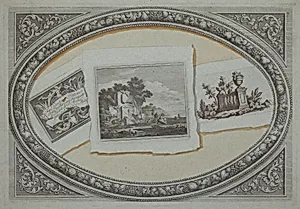
Trompe l'Oeil: Prints with Londonio's Calling Card, Using Original Copperplates
Medium
etching and engraving printed in black and brown with ochre watercolor on blue laid paper
Dimensions
plate: 25.8 x 37.5 cm (10 3/16 x 14 3/4 in.) sheet: 28.9 x 42.8 cm (11 3/8 x 16 7/8 in.)
Classification
Department
CG-E
Museum
National Gallery of Art, Washington, D.C.
Credit
Ellwanger/Mescha Collection
Accession Number
2006.163.7
Rights
Public Domain
Art Historical Context
This captivating print from around 1790 exemplifies the playful art of trompe l’œil, or “trick of the eye,” designed to fool viewers into mistaking the flat image for real objects. Created by artists associated with the Milanese 18th-century school, including Francesco Londonio and Benigno Bossi, the work features etched and engraved elements printed in black and brown ink, enhanced with delicate ochre watercolor washes on blue laid paper. The composition cleverly incorporates what appears to be a stack of prints alongside Londonio’s own calling card, all rendered using impressions from original copperplates—a nod to the collaborative and reproductive nature of printmaking at the time. Trompe l’œil prints like this one highlight the technical mastery of etching and engraving, techniques prized in 18th-century Europe for their ability to capture fine textures and depth. By simulating tangible items such as paper edges and handwritten text, the artists invite viewers to question the boundary between reality and representation. Produced in Milan during a period when print culture flourished among collectors and artists, the piece reflects the era’s fascination with illusion and intellectual wit. Housed in the National Gallery of Art as part of the Ellwanger/Mescha Collection, this modest yet sophisticated work (measuring roughly 10 by 15 inches in the plate) offers a charming glimpse into the creative circles of late-18th-century Italy.