
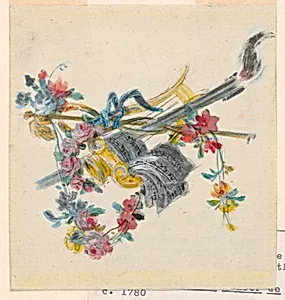
Trophy
ca. 1780
Medium
Drawing
Classification
Drawing
Department
Smithsonian Collection
Museum
Smithsonian American Art Museum
Credit
Purchased for the Museum by the Advisory Council
Accession Number
1911-28-268-2
Rights
Public Domain
About this artwork
Research in Progress
Art Historical Context
Pierre Ranson’s “Trophy,” created around 1780, offers a glimpse into the refined world of late eighteenth-century French design. As a drawing rather than a finished painting or print, the work likely served as a preparatory study or presentation piece, showcasing Ranson’s skill in capturing ornamental motifs. Drawings of this kind were essential tools for artists and artisans, allowing ideas to be refined before translation into tapestries, textiles, or decorative objects. Born in 1736, Ranson worked during a period when French decorative arts flourished under royal patronage and growing middle-class demand. His precise line work and balanced composition reflect the elegant tastes of the era, just before the French Revolution transformed artistic priorities. The title “Trophy” suggests a classical motif—often featuring weapons, armor, or symbolic objects arranged in harmonious groups—popular in both Rococo and emerging Neoclassical styles. Now part of the Smithsonian American Art Museum’s collection, this drawing was acquired through the Advisory Council to preserve examples of European draftsmanship. Though research on the piece continues, it remains a valuable window into the creative process of an accomplished French artist whose designs helped shape the visual culture of his time.