
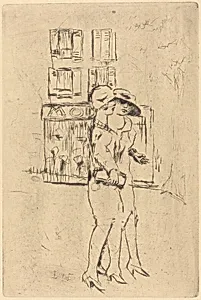
Trottins (Errand-girls)
c. 1927 (?)
Medium
drypoint
Dimensions
plate: 17.9 x 12 cm (7 1/16 x 4 3/4 in.) sheet: 26.3 x 19 cm (10 3/8 x 7 1/2 in.)
Classification
Department
CG-E
Museum
National Gallery of Art, Washington, D.C.
Credit
Virginia and Ira Jackson Collection, gift in memory of Virginia H. Jackson
Accession Number
2006.155.36
Rights
Public Domain
Art Historical Context
Pierre Bonnard's *Trottins (Errand-girls)*, created around 1927, is a drypoint print that captures the everyday bustle of Parisian street life. Depicting young women known as "trottins"—errand girls who darted between shops delivering messages and packages—this intimate work reflects Bonnard's fascination with fleeting urban moments. A leading figure in the Post-Impressionist Nabis group, Bonnard was renowned for his luminous paintings of domestic scenes, but his prints reveal a masterful command of line and texture in black-and-white. Drypoint, an intaglio technique where the artist scratches directly into a copper plate with a sharp needle, produces velvety lines enriched by the burr—a soft fuzz of raised metal that holds ink. Bonnard's sparing use of this method in the compact plate (17.9 x 12 cm) creates a hazy, atmospheric quality, evoking the movement of figures against a city backdrop. Though less celebrated than his color-saturated oils, these prints highlight his experimental side during the interwar years. Now housed in the National Gallery of Art's Virginia and Ira Jackson Collection, *Trottins* offers a charming glimpse into 1920s France, where such working girls symbolized the era's vibrant, modern energy. A perfect study in subtle artistry, it invites visitors to appreciate Bonnard's ability to distill poetry from the ordinary.
About the Artist
Pierre Bonnard · 1867–1947
Pierre Bonnard (1867–1947) was a French painter and printmaker who became a leading figure in the Post-Impressionist movement and a founding member of Les Nabis. Born on October 3, 1867, in Fontenay-aux-Roses, France, Bonnard initially studied law at his father's insistence, graduating and briefly practicing as a barrister in 1888. However, his true passion lay in art, and he had simultaneously at...