
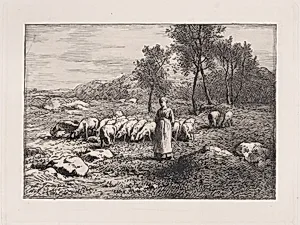
Troupeau de Porcs
1868
Medium
Etching and drypoint
Dimensions
Plate: 7 1/16 × 9 3/8 in. (18 × 23.8 cm) Image: 5 9/16 × 8 1/16 in. (14.1 × 20.4 cm)
Classification
Prints
Department
Drawings and Prints
Museum
Metropolitan Museum of Art, New York, NY
Credit
Harris Brisbane Dick Fund, 1927
Accession Number
27.10.76
Rights
Public Domain
Art Historical Context
**Troupeau de Por (Herd of Pigs)**, created by French artist Charles Jacque in 1868, offers a vivid glimpse into 19th-century rural life. Jacque, a prominent figure in the Barbizon School specialized in pastoral scenes featuring farm animals, drawing inspiration from the French countryside near Barbizon. This etching captures a herd of pigs in a natural setting, emphasizing the humble beauty of everyday barnyard existence during an era when Realism celebrated unidealized depictions of nature and labor. The work's medium—etching combined with drypoint—showcases Jacque's mastery as a printmaker. Etching involves incising lines into a metal plate with acid for precise, fluid contours, while drypoint adds a needle-scratched burr that yields soft, velvety textures ideal for rendering the pigs' bristly fur and earthy ground. At 7 1/16 × 9 3/8 inches, the intimate scale invites close viewing, highlighting the technique's richness in a compact format. Acquired through the Harris Brisbane Dick Fund in 1927, this print from the Metropolitan Museum of Art's Drawings and Prints department exemplifies Jacque's contribution to animalier art, blending technical innovation with affectionate observation of the animal world. A charming reminder of pastoral harmony amid industrial change.
About the Artist
Charles Jacque · 1813–1894
Charles-Émile Jacque (1813–1894) was a pioneering French painter, engraver, and illustrator whose career bridged the worlds of printmaking and pastoral painting. Born in Paris amid a difficult childhood, he apprenticed at age seventeen to a map engraver, mastering drypoint technique and producing his first etching in 1830—a copy of a head after Rembrandt. After serving seven years in the French Ar...