
Tsii' Edo' Ai
ca. 1887
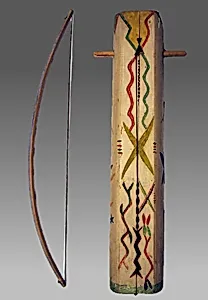
Medium
Wood; sinew, horsehair, polychrome
Dimensions
a) Body: L.15 1/2 × Diam. 3 in. (39.4 × 7.6 cm); b) bow: L. 17 in. (43.2 cm)
Classification
Chordophone-Zither-bowed
Culture
Native American (Apache)
Department
Musical Instruments
Museum
Metropolitan Museum of Art, New York, NY
Credit
The Crosby Brown Collection of Musical Instruments, 1889
Accession Number
89.4.600a, b
Rights
Public Domain
Art Historical Context
Nestled in the Metropolitan Museum of Art's Crosby Brown Collection of Musical Instruments *Tsii' Edo' Ai* (ca. 1887) is a captivating Apache bowed zither crafted by artisan Lawrence Gotelay. This American chordophone exemplifies the ingenuity of Apache musical traditions, where instruments like this served both ceremonial and social purposes, blending functionality with artistic expression. Dating to the late 19th century, it reflects a pivotal era when Apache communities maintained cultural practices amid rapid change from U.S. expansion. The instrument features a wooden body measuring 15½ inches long and 3 inches in diameter, paired with a 17-inch bow strung with sinew and horsehair. Polychrome decoration adorns its surface, highlighting the artisan's skill in vibrant coloring techniques that likely drew from natural pigments, adding visual rhythm to its resonant form. As a zither-bowed chordophone, it produces haunting, melodic tones by bowing taut strings over a soundboard, a rare and evocative design among Indigenous instruments. Gotelay's creation underscores the artistic mastery of Apache woodworkers, who transformed everyday materials into objects of profound cultural significance. Visitors can appreciate how *Tsii' Edo' Ai* bridges music, craft, and heritage, inviting us to imagine its songs echoing through Southwestern landscapes.