
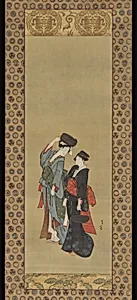
筑摩祭・鍋被り美人図 (Tsukuma matsuri, Nabe kaburi bijin zu)|Women Carrying Pots for the Tsukuma Festival
ca. early 1880s
Medium
Hanging scroll; partly woodblock printed, partly painted in ink and color on silk
Dimensions
Image: 33 9/16 × 12 3/8 in. (85.2 × 31.4 cm) Overall with mounting: 61 1/8 × 17 15/16 in. (155.3 × 45.6 cm) Overall with knobs: 61 1/8 × 20 1/8 in. (155.3 × 51.1 cm)
Classification
Paintings
Culture & Period
Japan · Meiji period (1868–1912)
Department
Asian Art
Museum
Metropolitan Museum of Art, New York, NY
Credit
Mary and Cheney Cowles Collection, Gift of Mary and Cheney Cowles, 2021
Accession Number
2021.398.40
Rights
Public Domain
Art Historical Context
Katsushika Hokus, the legendary Japanese artist renowned for his ukiyo-e prints like *The Great Wave offanagawa*, captures the vibrant spirit of tradition in *Women Carrying Pots for the Tsuk Festival* (筑摩祭・鍋被美人図), created around the early 1880s during Japan's Meiji period (1868–1912). This hanging scroll depicts graceful bijin—beautiful women—balancing pots on their heads during the Tsukuma Festival, a local celebration likely rooted in rural customs. Hokusai's keen eye for everyday life and human form brings these figures to life, their poised stances and flowing kimonos evoking both poise and festivity amid cultural transition. What sets this work apart is its innovative hybrid medium: partly woodblock printed for precise patterns and bold colors, then hand-painted in ink and color on silk for delicate details. Measuring about 33½ × 12⅜ inches, it's designed as a luxurious hanging scroll, blending mass-production efficiency with artisanal finesse—a nod to Meiji-era modernization while honoring Edo-period aesthetics. Housed in the Metropolitan Museum of Art's Asian Art Department, this piece from the Mary and Cheney Cowles Collection highlights Hokusai's enduring influence, showcasing bijin-ga (pictures of beautiful women) in a festival context that bridges Japan's past and evolving present. A delightful glimpse into joyous communal rituals!
About the Artist
Katsushika Hokusai 葛飾北斎 (Japanese) · 1760 –1849
Japanese, Tokyo (Edo) 1760–1849 Tokyo (Edo)