
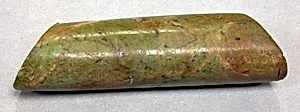
Tubular Bead
Unknown Artist
10th–4th century BCE
Medium
Stone
Dimensions
Height 2-7/8 in.
Classification
Beads-Ornaments
Culture
Olmec (?)
Department
Arts of Africa, Oceania, and the Americas
Museum
Metropolitan Museum of Art, New York, NY
Credit
Bequest of Arthur M. Bullowa, 1993
Accession Number
1994.35.510
Rights
Public Domain
Art Historical Context
This slender tubular bead, carved from stone and measuring 2-7/8 inches in height, hails from the enigmatic Olmec culture—or possibly associated with it—dating to the 10th–4th century BCE. The Olmecs, often called the "mother culture" of Mesoamerica, flourished in the Gulf Coast region of modern-day Mexico, pioneering monumental stone sculptures and intricate jade work. Though attributed questioningly to them, this ornament exemplifies the era's mastery of hard stone carving, likely achieved through patient abrasion with sandstone tools and water, transforming raw material into a polished, functional beauty. Beads and ornaments like this one held profound cultural weight in ancient Mesoamerican societies, serving as jewelry, trade goods, or ritual items symbolizing status and spiritual power. Its tubular form suggests it was strung into necklaces or belts, evoking the wearer's connection to ancestors or deities. Donated to the Metropolitan Museum of Art through the bequest of Arthur M. Bullowa in 1993, this artifact invites us to ponder the Olmecs' innovative artistry and their lasting influence on later civilizations like the Maya and Aztec. Housed in the Arts of Africa, Oceania, and the Americas department, the bead whispers of a world where everyday objects embodied cosmic significance, bridging the ancient past with our modern gaze.