
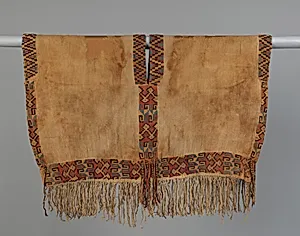
Tunic
Unknown Artist
7th century
Medium
Camelid hair
Dimensions
Overall: 33 in. (83.82 cm) Other: 24 in. (60.96 cm)
Classification
Textiles-Woven
Culture
Nasca
Department
Arts of Africa, Oceania, and the Americas
Museum
Metropolitan Museum of Art, New York, NY
Credit
Rogers Fund, 1928
Accession Number
28.171.13
Rights
Public Domain
Art Historical Context
This exquisite 7th-century tunic, crafted from camelid hair by an unknown Nasca artist, a vivid glimpse into the sophisticated textile traditions of ancient Peru. Hailing from the Nasca culture (ca. 100 BCE–800 CE) in the south coast region, it measures 33 inches overall, with a 24-inch body, and exemplifies the woven garments worn by elites. Acquired through the Rogers Fund in 1928, it resides in the Metropolitan Museum of's Department of Arts of Africa, Oceania, and the Americas. Nasca weavers were masters of their craft, transforming fibers from llamas or alpacas—prized for their strength, softness, and vibrant dye potential—into intricate textiles using techniques like tapestry weaving and supplementary weft patterning. These tunics often featured bold motifs of mythical creatures, warriors, and nature symbols, serving not just as clothing but as status symbols and ritual objects that conveyed social and spiritual narratives. The tunic's survival highlights the Nasca's enduring legacy in pre-Columbian art, where textiles rivaled ceramics and geoglyphs in complexity. For visitors, it underscores how Andean peoples wove stories into fabric, bridging the everyday and the divine in a harsh desert environment.