
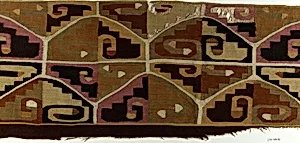
Tunic Fragment
Unknown Artist
7th–9th century
Medium
Cotton, camelid hair
Dimensions
Overall: 11 x 33 3/4 in. (27.94 x 85.73 cm) Other: 11 in. (27.94 cm)
Classification
Textiles-Woven
Culture
Wari
Department
Arts of Africa, Oceania, and the Americas
Museum
Metropolitan Museum of Art, New York, NY
Credit
Gift of George D. Pratt, 1933
Accession Number
33.149.92
Rights
Public Domain
Art Historical Context
This exquisite tunic fragment hails from the Wari culture of ancient Peru, dating to the 7th–9th century—a pivotal era when the Wari empire expanded across the Andes, fostering advanced artistic traditions. As part of the prestigious Arts of Africa, Oceania, the Americas collection at the Metropolitan Museum of, this woven textile (gift of George D. Pratt 1933) offers a glimpse into pre-Inca society, where clothing conveyed status, identity, and spiritual beliefs. Crafted from cotton and camelid hair—likely fine fibers from alpacas or llamas—the fragment showcases the Wari's mastery of weaving techniques. Measuring 11 x 33¾ inches overall, it exemplifies tapestry-style weaving, a labor-intensive process that intertwined dyed yarns to create vibrant patterns and motifs. Textiles like this were not mere garments but symbols of power, often worn by elites in rituals or buried with the dead, highlighting the culture's reverence for cloth as a medium of cosmic and social narratives. Though incomplete, this piece underscores the Wari's enduring legacy in Andean art, where textiles rivaled ceramics and metals in complexity and cultural weight. Visitors, imagine draping such a treasure across your shoulders— a tangible link to a thriving civilization's ingenuity!