
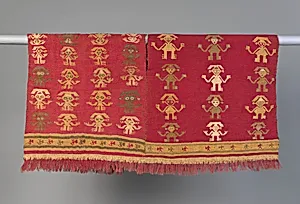
Tunic with Crescent Headdress Figures
Unknown Artist
ca. 1460–1540
Medium
Camelid wool, cotton
Dimensions
H. 22 x W. 39 3/4 in. (55.9 x 101 cm)
Classification
Textiles-Woven
Culture
Chimú
Department
Arts of Africa, Oceania, and the Americas
Museum
Metropolitan Museum of Art, New York, NY
Credit
The Michael C. Rockefeller Memorial Collection, Bequest of Nelson A. Rockefeller, 1979
Accession Number
1979.206.590
Rights
Public Domain
Tags
Art Historical Context
This vibrant Chimú tunic, woven from camelid wool and cotton around 1460–1540, the mastery of Andean textile arts on Peru's north coast. Measuring 22 by 39 3/4 inches, it features repeating human figures adorned with distinctive crescent-shaped headdresses, representing elite warriors, deities, or ancestors. These motifs, rendered in bold colors and intricate patterns, reflect the Chimú culture's sophisticated iconography, which blended daily life with spiritual beliefs during their flourishing pre-Inca empire. Chimú weavers were renowned innovators, employing advanced techniques like complementary warp weaving to create durable, reversible fabrics from fine alpaca or llama wool dyed with natural pigments, combined with cotton for structure. Such tunics served as elite garments, worn by nobility or used in rituals, symbolizing status and cosmological power. Produced in the late Chimú period, just before Inca conquest around 1470, this piece captures a pivotal moment in Andean history. Today, housed in The Metropolitan Museum of Art's Michael C. Rockefeller Memorial Collection, it highlights the Chimú's enduring legacy in textiles—once as precious as gold—offering visitors a tactile glimpse into a vanished world of artistry and reverence.