
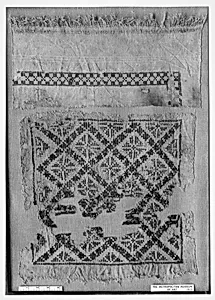
Tunic with Interlace Decoration
Unknown Artist
4th–8th century
Medium
Linen, wool
Dimensions
H. 50 in. (127 cm) W. 30 1/2 in. (77.5 cm)
Classification
Textiles
Department
Islamic Art
Museum
Metropolitan Museum of Art, New York, NY
Credit
Gift of George F. Baker, 1890
Accession Number
90.5.903
Rights
Public Domain
Art Historical Context
Step into the enchanting world of early Islamic textiles this *Tunic with Interlace*, a remarkable survivor from the 4th–8th century.ed from linen and wool, this garment measures an impressive 50 inches high and 30½ inches wide, designed for everyday wear in the ancient Near East. Its bold interlace patterns—intricate woven motifs resembling endless knots—evoke the geometric complexity that became a hallmark of Islamic art, symbolizing unity and eternity. Produced during a pivotal era bridging late antiquity and the rise of Islam, the tunic highlights advanced textile techniques like tapestry weaving, where colored wool yarns create vivid designs against a linen ground. Such garments were essential in daily life, traded across vast regions from Egypt to Central Asia, reflecting cultural exchanges and skilled craftsmanship in workshops like those in Fustat. Displayed in the Metropolitan Museum of Art's Islamic Art department, this piece—generously gifted by George F. Baker in 1890—offers a tangible link to the past. It invites us to imagine wearers navigating bustling markets or serene mosques, wrapped in patterns that whisper of artistic innovation and spiritual depth.