
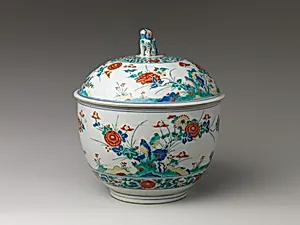
Tureen with rocks, flowers, and birds
Unknown Artist
18th century
Medium
Porcelain painted with cobalt blue under and colored enamels over transparent glaze (Arita ware; Kakiemon type)
Dimensions
H. 13 3/4 in. (34.9 cm); Diam. 12 3/8 in. (31.4 cm)
Classification
Ceramics
Culture & Period
Japan · Edo period (1615–1868)
Department
Asian Art
Museum
Metropolitan Museum of Art, New York, NY
Credit
The Harry G. C. Packard Collection of Asian Art, Gift of Harry G. C. Packard, and Purchase, Fletcher, Rogers, Harris Brisbane Dick, and Louis V. Bell Funds, Joseph Pulitzer Bequest, and The Annenberg Fund Inc. Gift, 1975
Accession Number
1975.268.526a, b
Rights
Public Domain
Tags
Art Historical Context
This exquisite 18th-century porcelainureen from Japan's Edo period (1615–1868) exemplifies the mastery of Arita ware, the renowned Kakiemon style.ed as a lidded serving vessel for soups or stews—standing 13¾ inches tall with a 12⅜-inch diameter—it features a pristine white body adorned with asymmetrical motifs of rugged rocks, blooming flowers, and graceful birds. These naturalistic designs, painted in cobalt blueglaze and vibrant colored enamels over a transparent, evoke the serene beauty of nature, a hallmark of Japanese aestheticsKakiemon porcelain, produced in Arita kilns in Saga Prefecture, represented a pinnacle of technical innovation during the Edo era. The underglaze cobalt provided durable blue tones, while overglaze enamels added delicate pinks, greens, and yellows, fired at high temperatures for lasting brilliance. This sparse, elegant decoration contrasted with denser Chinese styles, making Kakiemon highly prized for export to Europe via the Dutch East India Company, where it inspired luxury ceramics at factories like Meissen. Housed in the Metropolitan Museum of Art's Asian Art Department as part of The Harry G. C. Packard Collection, this tureen highlights Japan's role in global trade and artistic exchange. Its functional form belies its status as a collector's gem, blending everyday utility with poetic refinement.