
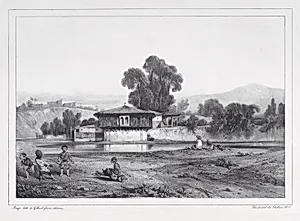
Turkish Barrack
Medium
Lithograph
Dimensions
Sheet: 11 7/16 × 16 1/16 in. (29 × 40.8 cm)
Classification
Prints
Department
Drawings and Prints
Museum
Metropolitan Museum of Art, New York, NY
Credit
The Elisha Whittelsey Collection, The Elisha Whittelsey Fund, 1964
Accession Number
64.605.11
Rights
Public Domain
Art Historical Context
Alexandre-Gabriel Decamps’s *Turkish Barrack* captures the nineteenth-century European fascination with the Ottoman world through the accessible medium of lithography. Created between 1823 and 1860 and printed by the Paris firm Gihaut Frères, the work belongs to the wave of Orientalist imagery that followed Napoleon’s Egyptian campaign and the growing diplomatic and artistic exchanges between France and the Near East. Decamps, a leading figure of the Romantic generation, traveled to Turkey and North Africa, bringing back vivid impressions that he translated into both paintings and widely circulated prints. As a lithograph measuring roughly 11 by 16 inches, the sheet exemplifies the period’s new reproductive technology, which allowed artists to reach broader audiences beyond the Salon. The barracks scene would have offered viewers a romanticized glimpse of military life in the Ottoman Empire—turbans, architecture, and daily routines—rendered with Decamps’s characteristic attention to light and local detail. Today in the Metropolitan Museum’s collection as part of the Elisha Whittelsey Fund, the print preserves both an artistic record of cross-cultural curiosity and a fine example of early lithographic draftsmanship.
About the Artist
Alexandre-Gabriel Decamps|Gihaut Frères|Gihaut Frères · 1803–1860
Comment on works: genre