
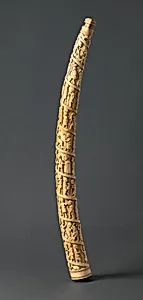
Tusk with figurative relief
ca. 1880–1890
Medium
Ivory
Dimensions
H. 31 x W. 4 3/4 x D. 2 1/2 in. (H. 78.7 x W. 12.1 x D. 6.4 cm.)
Classification
Bone/Ivory-Sculpture
Culture
Kongo, Vili group
Department
Arts of Africa, Oceania, and the Americas
Museum
Metropolitan Museum of Art, New York, NY
Credit
Gift of Marian Malcolm, in loving memory of her husband, Daniel Malcolm, 2022
Accession Number
2022.516.1
Rights
Public Domain
Art Historical Context
This exquisite *Tusk with Figurative Relief*, crafted by a Kongo from the Vili group 1880–1890, exemplifies the of ivory carving in Central Africa. Standing at an impressive 31 inches tall, the sculpture transforms a natural elephant tusk into a narrative canvas, its surface adorned with intricate reliefs depicting human figures. Ivory, prized for its creamy luster and workability, was a highly valued medium among the Kongo peoples, often sourced from trade networks and shaped with fine tools to reveal layered scenes. Historically, such tusks emerged during a period of intense cross-cultural exchange in the late 19th century, when Vili artisans in the Democratic Republic of Congo and Angola region produced these works for both local prestige and European markets. The figurative reliefs likely illustrate daily life, status symbols, or spiritual motifs central to Kongo cosmology, blending realism with stylized forms characteristic of the culture's sculptural tradition. Today, this gift to the Metropolitan Museum of Art honors the legacy of collectors Marian and Daniel Malcolm. It invites visitors to appreciate the Vili artists' technical prowess—evident in the tusk's smooth curves and detailed incising—and the enduring cultural dialogue it represents between African ingenuity and global appreciation.