
Tweezers (?)
Unknown Artist
1st–mid-16th century
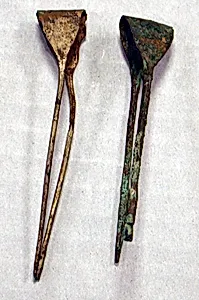
Medium
Copper (hammered), silver (?)
Dimensions
H x W: 3 1/8 x 5/8 in. (7.9 x 1.6 cm)
Classification
Metal-Implements
Culture
Peru; north coast (?)
Department
Arts of Africa, Oceania, and the Americas
Museum
Metropolitan Museum of Art, New York, NY
Credit
Gift of Mr. and Mrs. Nathan Cummings, 1964
Accession Number
64.228.600
Rights
Public Domain
Art Historical Context
This delicate pair of tweezers, tentatively identified as such, hails from Peru's north coast and dates to the 1 through mid-16th century—a span encompassing vibrant pre-Columbian cultures like the Moche and Chimú, up to the early years of Spanish colonial influence. Crafted as a metal implement, it reflects the sophisticated metallurgical traditions of ancient Andean societies, where copper tools were essential for daily life grooming, or even ritual. Its small size—measuring just 3 1/8 by 5/8 inches—suggests portability, perhaps carried by individuals for personal use. Hammered from copper, with possible silver accents, the tweezers showcase skilled craftsmanship: the labor-intensive hammering technique allowed artisans to shape thin, durable sheets without advanced machinery, highlighting resourcefulness and precision in pre-industrial Peru. Such objects, now housed in the Metropolitan Museum of Art's Department of Arts of Africa, Oceania, and the Americas (gift of Mr. and Mrs. Nathan Cummings, 1964), offer a glimpse into everyday Andean ingenuity. While exact cultural attributions remain uncertain, they embody the north coast's legacy of fine metalwork, bridging utility and artistry across centuries.