
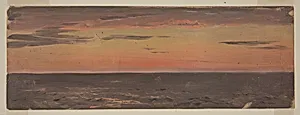
Twilight at Sea, Canada
June–July 1859
Medium
seascapes
Classification
seascapes
Department
Smithsonian Collection
Museum
Smithsonian American Art Museum
Credit
Gift of Louis P. Church
Accession Number
1917-4-802
Rights
Public Domain
About this artwork
Research in Progress
Art Historical Context
Frederic Edwin Church, a leading figure of the Hudson River School, captured the serene beauty of nature in *Twilight at Sea, Canada painted during June–July 1859. As an American artist (1826–1900), Church was renowned for his luminous landscapes and seascapes that celebrated the grandeur of the natural world, often infused with Romantic ideals of the sublime. This work reflects his fascination with atmospheric effects, particularly the tranquil transition from day to dusk over vast waters, likely inspired by coastal scenes near Canada. Church's technique emphasized meticulous detail and radiant light, hallmarks of Luminism—a style he helped pioneer—where subtle gradations of color evoke a sense of divine harmony in nature. Created in the mid-19th century amid growing American interest in national landscapes, the painting underscores themes of exploration and wilderness, aligning with Church's expeditions to remote locales. Though specific details are under research, its classification as a seascape highlights his mastery of marine subjects. Today, *Twilight at Sea, Canada* graces the Smithsonian American Art Museum, a gift from Louis P. Church. It invites visitors to ponder the timeless allure of twilight's glow, bridging 19th-century artistic innovation with our enduring awe for the sea.