
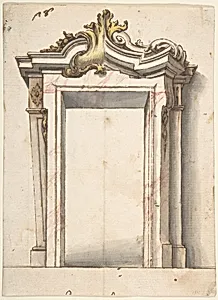
Two Alternate Designs for a Doorway
Medium
Pen and brown ink, brush and brown, gray, yellow, and red wash, over leadpoint or graphite
Dimensions
Sheet: 7-11/16 x 5-11/16 in. (19.55 x 14.4 cm)
Classification
Drawings
Department
Drawings and Prints
Museum
Metropolitan Museum of Art, New York, NY
Credit
Purchase, Joseph Pulitzer Bequest, 1965
Accession Number
65.653.39
Rights
Public Domain
Tags
Art Historical Context
This delicate drawing, *Two Alternate Designs for away*, hails from anonymous Piedmontese hands in northern Italy around 1730–60. Created during the opulent Baroque-to-Rococo transition, showcases two ornate doorway proposals, rich with scrolling motifs, pediments, and decorative flourishes typical of the era's architectural ornamentation. Such designs would have graced grand palazzos or churches in Piedmont—a region centered around Turin, blending local Italian traditions with French-inspired elegance. The artist employed a meticulous mixed-media technique: subtle leadpoint or graphite underdrawing for initial sketches, refined with pen and brown ink outlines, then enlivened by brush washes in brown, gray, yellow, and red. These colored washes add depth, shadow, and warmth, simulating stone or stucco textures and helping clients visualize the final carved or sculpted doorways. At just 7-11/16 x 5-11/16 inches, its compact scale belies the grandeur of the concepts, highlighting the precision of 18th-century draftsmen. Preserved in The Metropolitan Museum of Art's Drawings and Prints department (purchase from the Joseph Pulitzer Bequest, 1965), this sheet offers a window into the collaborative world of architectural design, where alternate ideas sparked innovation in Europe's lavish built environment.