
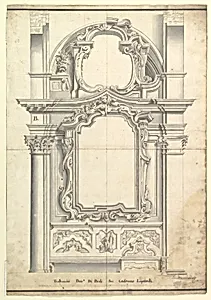
Two Alternate Designs for a Wall with a Frame for a Painting
Medium
Pen and gray ink, brush and gray wash, over graphite or leadpoint, with ruled and compass construction. Framing outlines in pen and dark gray ink. Scale, at bottom, in pen and gray ink
Dimensions
sheet: 22 11/16 x 15 11/16 in. (57.6 x 39.8 cm)
Classification
Drawings
Department
Drawings and Prints
Museum
Metropolitan Museum of Art, New York, NY
Credit
Gift of Leon Dalva Sr., 1965
Accession Number
65.654.4
Rights
Public Domain
Tags
Art Historical Context
This exquisite 18th-century drawing anonymous Piedmontese artists in northern Italy presents two alternate designs for a featuring an elaborate frame for a painting. between 1700 and 1780, it reflects the opulent architectural tastes of the Savoy court in Turin, where intricate cartouches—ornamental-like frames—adorned palaces and churches during the late Baroque and emerging Rococo periods. These designs showcase how decorators envisioned harmonious integration of art into grand interiors, blending functionality with lavish decoration. The artist's meticulous technique underscores its practical purpose: faint graphite or leadpoint underdrawing establishes the composition, followed by precise ruled and compass lines for geometric accuracy. Pen and gray ink delineate forms, with brush and gray wash adding subtle tonal depth and shadow, while darker framing outlines and a bottom scale in ink ensure real-world scalability for builders. This layered approach highlights the collaborative craft of 18th-century draftsmen, bridging architecture and interior design. Housed in the Metropolitan Museum of Art's Drawings and Prints department as a 1965 gift from Leon Dalva Sr., this sheet offers a rare glimpse into the preparatory artistry behind Italy's gilded rooms, inviting us to appreciate the unseen planning that elevated everyday walls to masterpieces.