
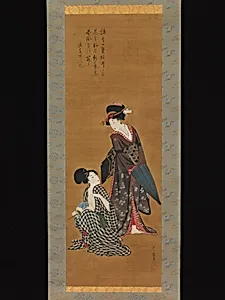
Two Beauties
ca. 1801–4
Medium
Hanging scroll; ink and color on silk
Dimensions
Image: 40 3/4 x 12 1/2 in. (103.5 x 31.8 cm) Overall with mounting: 69 11/16 x 19 1/2 in. (177 x 49.5 cm) with ivory rollers (dia. 15/16 in.)
Classification
Paintings
Culture & Period
Japan · Edo period (1615–1868)
Department
Asian Art
Museum
Metropolitan Museum of Art, New York, NY
Credit
Charles Stewart Smith Collection, Gift of Mrs. Charles Stewart Smith, Charles Stewart Smith Jr., and Howard Caswell Smith, in memory of Charles Stewart Smith, 1914
Accession Number
14.76.70b
Rights
Public Domain
Tags
Art Historical Context
**Two Beauties** by Kitagawa Utamaro created around 1801–4, captures the refined allure of women during Japan's Edo period (1615–1868). This hanging scroll, rendered in ink and color on silk, measures an impressive 40 3/4 x 12 1/2 inches, designed for intimate display in a private setting. Utamaro, a master of ukiyo—the "pictures of the floating world"—specialized in *bijin-ga*, sensitive portraits of beautiful women, often courtesans or everyday beauties. Here, the two figures embody his signature style: elongated forms, soft contours, and luminous skin tones that convey grace and sensuality. Utamaro's technique shines through delicate line work and subtle color gradients on silk, a luxurious medium that allowed for vibrant yet ethereal effects, heightening the scroll's tactile appeal. Produced late in his career (he died in 1806), it reflects the booming woodblock print culture while elevating painting to elite connoisseurship. Hanging scrolls like this were unrolled for personal admiration, offering a window into Edo urban life, where beauty and transience were celebrated amid kabuki theaters and pleasure districts. Today, housed in the Metropolitan Museum of Art's Asian Art Department as part of the Charles Stewart Smith Collection (gifted in 1914), *Two Beauties* invites visitors to appreciate Japan's artistic legacy of feminine elegance and masterful craftsmanship.
About the Artist
Kitagawa Utamaro · 1753–1806
Kitagawa Utamaro (c. 1753-1806) was one of the most celebrated masters of ukiyo-e woodblock printing, revolutionizing the art of bijin-ga (pictures of beautiful women) during Japan's Edo period. Born Kitagawa Ichitaro, his early life remains shrouded in mystery, with conflicting accounts placing his birth in Kyoto, Osaka, Yoshiwara in Edo (modern Tokyo), or Kawagoe in Musashi Province. Under the t...