
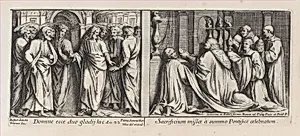
Two Biblical Scenes: The Apostles Showing Christ their Swords at left, after Raphael's Stanza della Segnatura and the Pope Celebrates Mass with Four Priests,after Raphael's Stanza di Eliodoro, from a series of 15 plates depicting Raphael's works for the Vatican stanze and the Sistine Chapel tapestries
Medium
Etching
Dimensions
Sheet: 4 9/16 × 11 5/16 in. (11.6 × 28.8 cm) Plate: 4 1/8 × 10 1/16 in. (10.5 × 25.6 cm)
Classification
Prints
Department
Drawings and Prints
Museum
Metropolitan Museum of Art, New York, NY
Credit
Gift of Harry G. Friedman, 1959
Accession Number
59.644.8(11)
Rights
Public Domain
Art Historical Context
This exquisite etching captures two vivid biblical scenes inspired by Raphael's masterful frescoes in the Vatican Stanze: on the left, the Apostles their swords to Christ, echoing motifs from the Stanza della Segnatura on the right, a pope celebrating Mass with four priests, drawn from the Stanza diodoro. Created by Pietro Santi Bartoli 1650 and 1670, and published by Giovanni Giacomo De, it forms part of a prestigious series of 15 plates that faithfully reproduced Raphael's iconic Vatican commissions and designs for the Sistine Chapelestries. Raphael (1483–1520), the High Renaissance genius, adorned Pope Julius II's apartments with these frescoes around 1508–1511, blending classical harmony, dramatic narrative, and profound religious symbolism. Bartoli's etching technique—using acid to bite intricate lines into a copper plate—allowed for precise, tonal reproductions that brought Raphael's grandeur to a wider audience in the Baroque era, long before modern photography. At just over 4 by 11 inches, this intimate print exemplifies 17th-century Italy's reverence for Renaissance masters. Housed in the Metropolitan Museum of Art's Drawings and Prints department (gift of Harry G. Friedman, 1959), it highlights how prints democratized art, preserving and disseminating cultural treasures across Europe. A testament to enduring artistic legacy!
About the Artist
Pietro Santi Bartoli|Raphael (Raffaello Sanzio or Santi)|Giovanni Giacomo De Rossi · 1615–1700
Pietro Santi Bartoli, born in Perugia in 1635, emerged as a pivotal figure in the Roman antiquarian revival of the late seventeenth century. Relocating to Rome as a youth, he initially pursued painting, studying under the French artist Jean Lemaire—known as "Le Petit Lemaire"—and later under the esteemed Nicolas Poussin, whose classical rigor profoundly shaped his early approach. Though traces of ...