
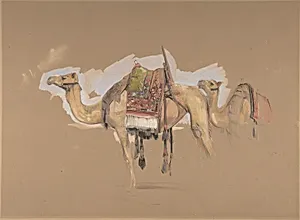
Two Camels
ca. 1843
Medium
Watercolor and gouache (bodycolor) over black chalk on brownish paper
Dimensions
sheet: 14 5/8 x 20 5/8 in. (37.1 x 52.4 cm)
Classification
Drawings
Department
Drawings and Prints
Museum
Metropolitan Museum of Art, New York, NY
Credit
Anonymous Gift, 1961
Accession Number
61.218.1
Rights
Public Domain
Tags
Art Historical Context
John Frederick Lewis's *Two Camels* (ca. 1843) captures the majestic presence of these desert icons in a luminous watercolor and gouache over black chalk on brownish paper. Created during Lewis's immersive travels in Egypt and the Middle East from 0 to 1851, the work reflects the 19th-century British fascination with Orientalism—a movement that romanticized Eastern cultures through precise, ethnographic detail. Lewis, a leading figure in this genre, transformed watercolor into a medium rivaling oil painting, showcasing camels as noble symbols of endurance and exotic allure. The artist's technique shines here: black chalk underdrawings on tinted paper provide a shadowy foundation, while layered watercolor and opaque gouache (bodycolor) build vivid textures—from the camels' shaggy fur to the subtle play of light on their forms. Measuring 14⅝ × 20⅝ inches, this drawing exemplifies Lewis's hyper-realistic style, honed through years of on-site sketching, which influenced later Victorian artists and collectors. Housed in the Metropolitan Museum of Art's Drawings and Prints department (Anonymous Gift, 1961), *Two Camels* invites visitors to ponder the cultural bridge between East and West, highlighting how everyday subjects like these "ships of the desert" embodied adventure and imperial curiosity in Victorian Britain.